Tommy Robinson: Racism, Symbols, Contradictions and Associations!
From St George to Grooming Gangs

Introduction
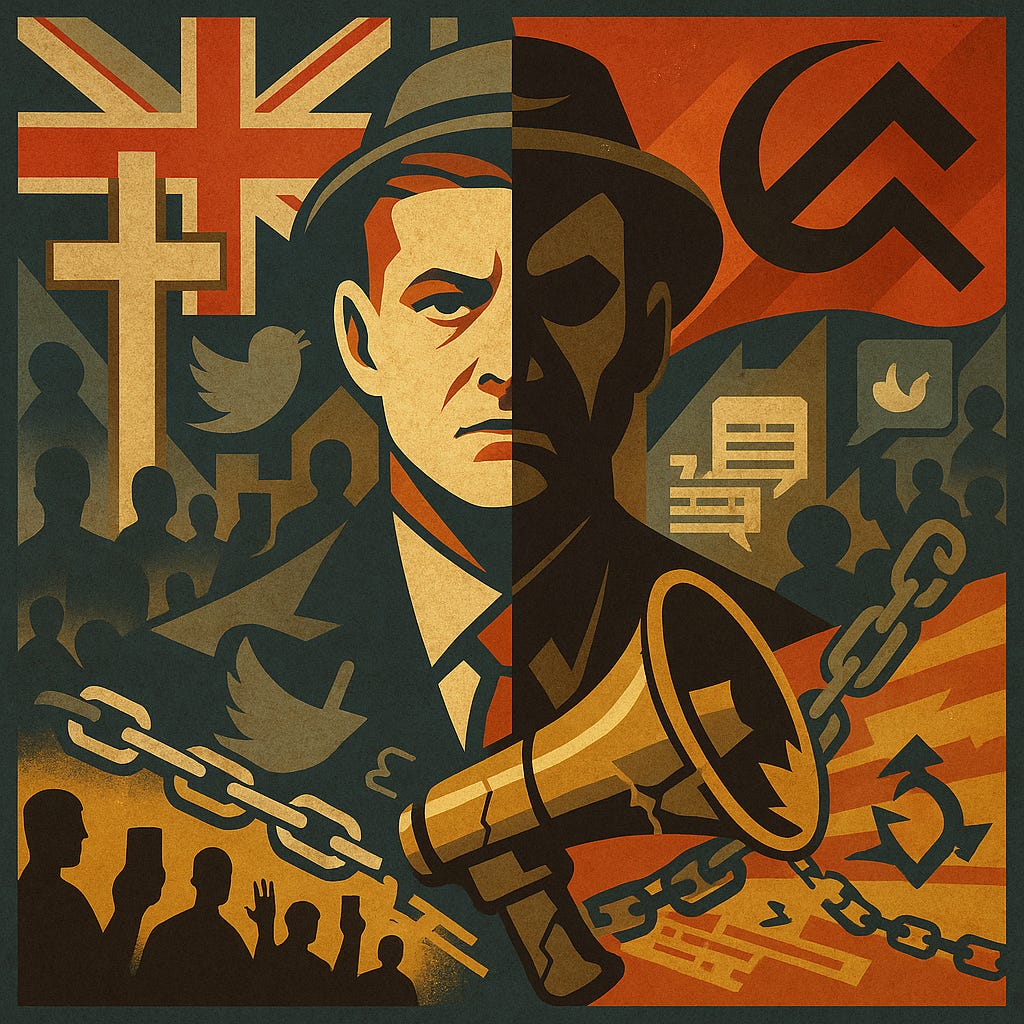
Stephen Yaxley-Lennon, widely known under the pseudonym Tommy Robinson, has positioned himself over the past fifteen years as one of the most prominent far-right activists in the United Kingdom. Through street demonstrations, online media, and increasingly large rallies, he has cultivated a public image as a “defender” of women, national identity, and free speech. Yet this self-presentation stands in tension with both his personal criminal record and the documented conduct of some figures associated with organisations he has led or inspired.
This article sets out to provide a critical guide to Robinson’s activism, symbols, contradictions, and associations. It explores four main areas: the historic and cultural contradictions embedded in the symbols Robinson deploys; the legal record that undermines his claims to moral authority; the connections between movements he has helped to lead and individuals convicted of serious crimes, including sexual abuse; and the ideological inconsistencies that emerge when Robinson associates himself with causes and symbols whose histories complicate his narratives.
Care is taken to remain within the bounds of verifiable fact. This means relying on court judgments, mainstream media reporting, and reputable monitoring groups. Where Robinson or his supporters deny allegations, or where claims remain contested, these will be noted. The aim is not slander but analysis: to assess whether the evidence supports Robinson’s self-presentation as a champion of women and national culture.
Background of Robinson
Stephen Yaxley-Lennon was born in Luton in 1982 and grew up in a working-class family. In the late 2000s, amid local tensions over immigration and Islam, he co-founded the English Defence League (EDL), which emerged in 2009 as a street protest movement opposing what it termed the “Islamification” of Britain (Copsey, 2010). The EDL distinguished itself from earlier far-right groups such as the National Front (NF) and British National Party (BNP) by emphasising an anti-Islamist rather than explicitly racial nationalist agenda. However, monitoring groups such as Hope Not Hate and academics studying the movement note that its demonstrations frequently descended into racist chanting, violence, and intimidation of Muslim communities (Allen, 2011).
Robinson himself was the most visible leader of the EDL. Under his leadership, the group regularly displayed the Union Jack and St George’s Cross at rallies. It also adopted the unusual tactic, for a far-right street movement, of flying the Israeli flag, as a way of presenting the organisation as opposed to antisemitism and aligned with Israel against “Islamism” (Garbaye, 2014). Robinson left the EDL formally in 2013, later claiming that he wanted to distance himself from the extremists and violent elements that the movement attracted (BBC News, 2013). Yet the pattern of appropriating national and religious symbolism has remained central to his activism.
Beyond his activism, Robinson’s criminal record dates back to the mid-2000s. He has been convicted for assault, mortgage fraud, illegal entry into the United States on a false passport, contempt of court, and harassment of a journalist (The Week, 2021; The Guardian, 2024). These convictions complicate his claim to stand for law and order. They also illustrate the contradictions between his projected role as a “protector” of women and children and the reality of his behaviour under the law.
Symbols and Symbolic Identity
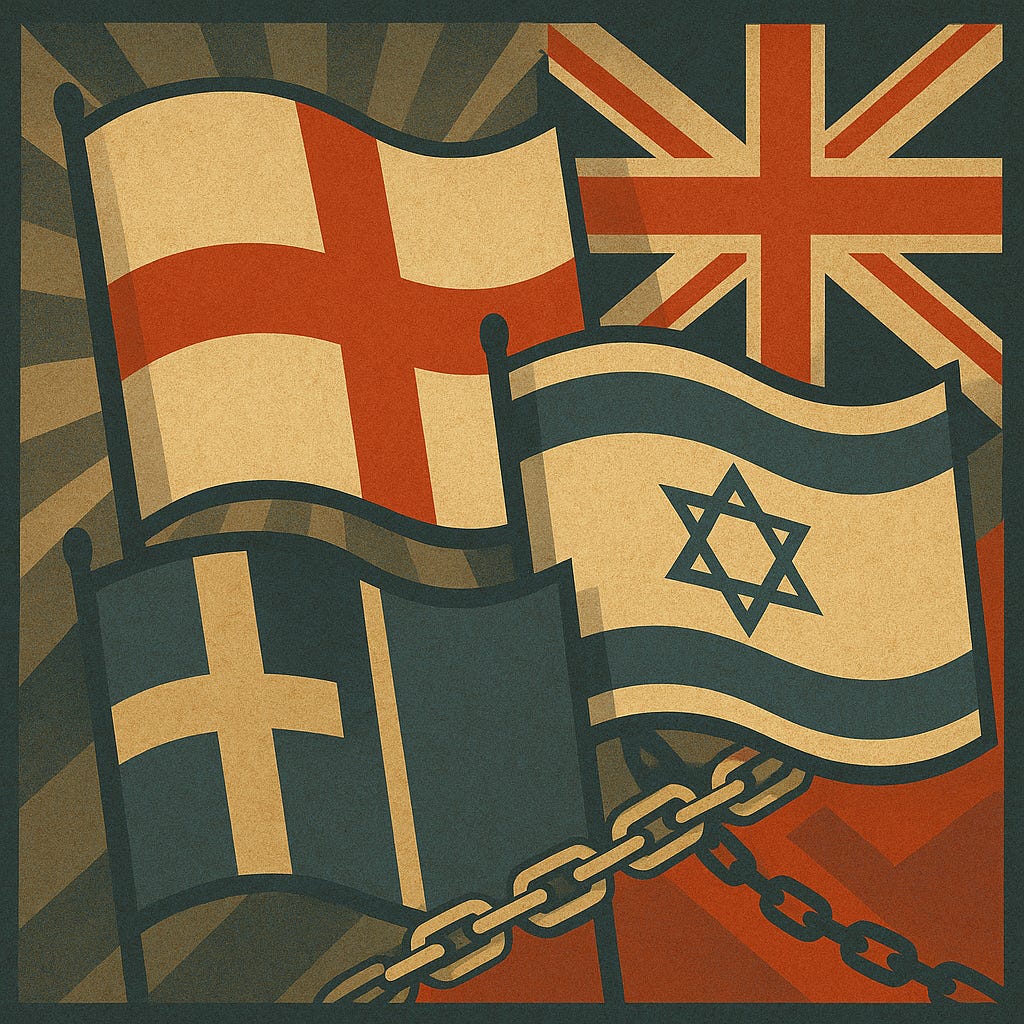
Robinson’s activism has consistently drawn on a repertoire of national and religious symbols. Chief among these are the Union Jack, the St George’s Cross, and the Israeli flag. Each carries historic weight and cultural contradictions.
The Union Jack is a composite national flag that has long been appropriated by far-right groups to symbolise ownership of “Britishness.” Scholars note that while the flag is officially a symbol of unity across England, Scotland and Northern Ireland, in far-right discourse it becomes a banner of exclusion, signalling who does and does not belong within the imagined community (Kenny, 2017).
The St George’s Cross, a red cross on a white field, is the flag of England. Its appropriation by Robinson and the EDL draws heavily on associations with the medieval Crusades. Yet historical accounts emphasise that St George himself was of Middle Eastern origin, believed to have been martyred in Lydda (modern-day Lod, in Israel/Palestine) (Bozóky, 2006). This creates an irony: the symbol Robinson employs to mark English nativism originates from a Levantine Christian figure whose legacy is also venerated across Palestinian and Middle Eastern traditions.
Robinson’s use of the Israeli flag has drawn widespread attention. At EDL rallies from 2009 onwards, demonstrators prominently displayed Israeli flags alongside English ones (Allen, 2011). This was a calculated move. By aligning with Israel, Robinson sought to distinguish the EDL from older antisemitic far-right groups such as the National Front and the BNP. It also allowed him to present the EDL as standing in solidarity with Jews against “Islamic extremism.” Jewish organisations, however, often rejected this claim. The Board of Deputies of British Jews, for example, condemned the EDL’s attempts to court Jewish support, pointing out that the movement still attracted antisemites and neo-Nazis (The Jewish Chronicle, 2010).
Thus, Robinson’s symbolic identity is stitched together from flags and icons that communicate patriotism and a selective narrative of Judeo-Christian civilisation. Yet these symbols carry contradictory histories: Crusaders massacred Jews as well as Muslims; St George was Middle Eastern, not English; and the Union Jack has long been contested as a flag of inclusion versus exclusion.
Hypocrisy and Contradictions in Conduct
Robinson’s own conduct and legal history further undercut his claims of defending women, children and national law. A central theme of his activism has been to expose and condemn sexual abuse within Muslim grooming gangs. Yet public records reveal that members of organisations associated with Robinson have themselves been convicted of child sexual offences (Hope Not Hate, 2019). For instance, Richard Price, one of the EDL’s original organisers, was convicted in 2010 for possessing indecent images of children (Hope Not Hate, 2019). Similarly, Leigh McMillan, identified in court as a senior EDL member, was jailed in 2018 for sexually abusing a ten-year-old girl (Birmingham Mail, 2018). While these convictions do not implicate Robinson personally, they challenge the movement’s narrative of moral authority.
Robinson himself has a significant criminal record. Convictions for assaulting an off-duty police officer (2005), entering the United States on a false passport (2012), and mortgage fraud (2014) undermine his credibility as a champion of law and order (The Week, 2021). His contempt of court convictions (2017–2018) are especially telling: while claiming to expose injustices against women, his actions risked collapsing ongoing grooming trials, potentially harming the very victims he claimed to defend (BBC News, 2018).
Moreover, his harassment of journalist Lizzie Dearden and her partner, which resulted in a five-year stalking protection order in 2021, directly contradicts his rhetoric of protecting women (The Guardian, 2021). These contradictions between proclaimed values and actual conduct form a key axis of hypocrisy: Robinson positions himself as a moral guardian, yet his record demonstrates repeated breaches of law, violence, fraud, and harassment.
Associations with Convicted Persons
Although Robinson has repeatedly claimed to expose sexual abuse in Muslim communities, evidence shows that several members and associates of movements he has led, particularly the English Defence League (EDL) who have themselves been convicted of sexual offences and violent crimes. This does not demonstrate Robinson’s personal involvement in such crimes. However, it illustrates a significant contradiction: while Robinson mobilises moral outrage at the abuse of women and children, some of those attracted to his movements have engaged in precisely the conduct he condemns.
One of the earliest cases was Richard Price, an EDL co-organiser convicted in 2010 of possessing indecent images of children (Hope Not Hate, 2019). Robinson later condemned Price publicly, but the fact that a founding figure of the organisation was convicted of such offences undermined the EDL’s credibility.
In 2018, Leigh McMillan, described by press reports as a senior EDL member, was jailed for sexually abusing a ten-year-old girl (Birmingham Mail, 2018). That same year, Peter Gillett, a regular EDL speaker from West Sussex, was convicted of multiple rapes, indecent assaults, and child cruelty, receiving an 18-year sentence (The Argus, 2018).
Convictions extend beyond the EDL. Jack Renshaw, who began in the BNP Youth before joining National Action, was convicted in 2018 of inciting a child to engage in sexual activity (Casciani, 2019). Similarly, Martyn Gilleard, a neo-Nazi associated with the National Front, was jailed in 2008 after police found nail bombs during a child pornography investigation; he was described in court as a paedophile (Hope Not Hate, 2019).
Although not all of these figures were directly tied to Robinson personally, they were active within the far-right ecosystem that he helped to shape or that overlaps with his networks. Their convictions show that sexual abuse is not unique to the communities Robinson targets, but is also present within the very organisations that support or amplify his message.
Recent Events: The “Unite the Kingdom” Rally
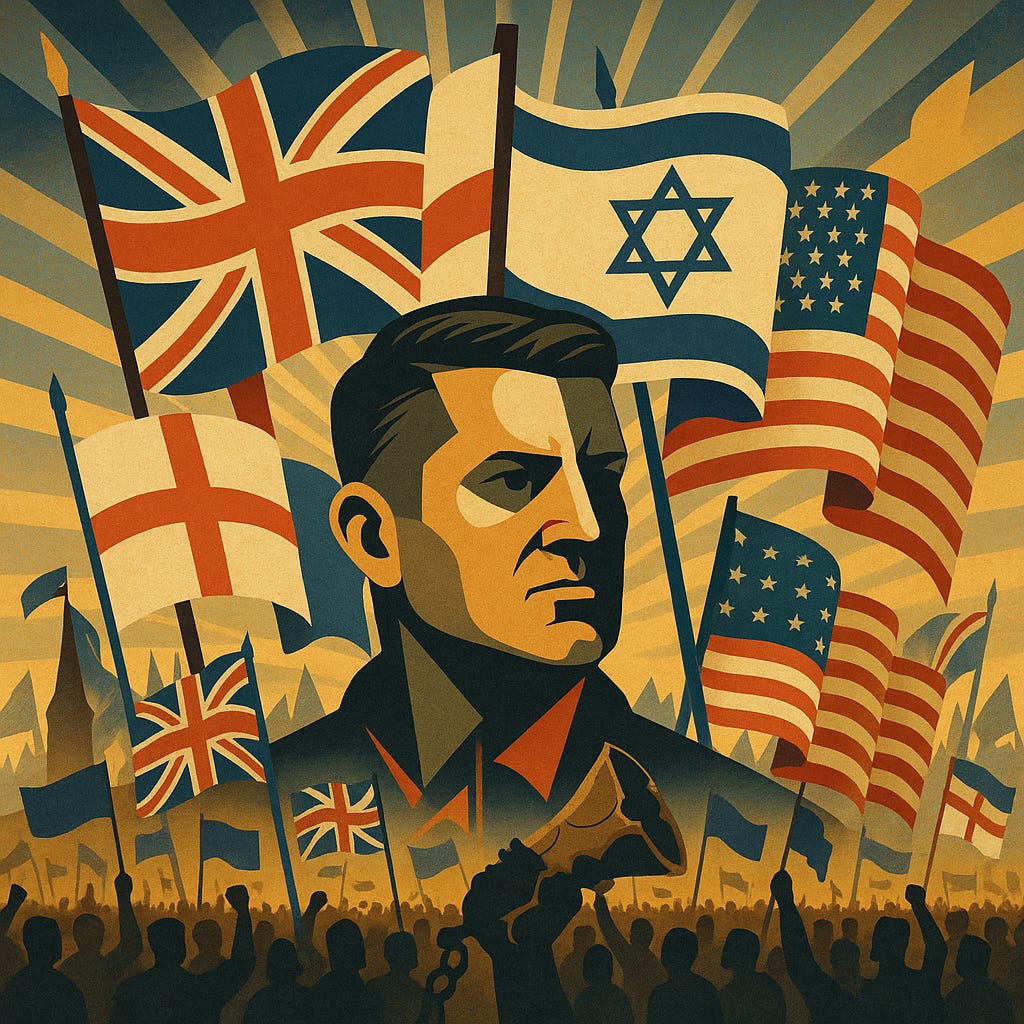
On 13 September 2025, Robinson staged what became his largest demonstration to date, under the banner “Unite the Kingdom.” Estimates suggest that between 110,000 and 150,000 people (other outlets suggest higher numbers) joined the rally in central London (Al Jazeera, 2025). The event was framed as a patriotic demonstration, but its themes extended far beyond unionism.
The rally brought together a coalition of groups and causes: anti-immigration campaigners, anti-trans activists, anti-Palestinian demonstrators, and supporters of Robinson’s broader anti-Islam platform (Reuters, 2025). Protesters carried Union Jacks, St George’s Crosses, American flags, and Israeli flags, a visual continuation of Robinson’s symbolic repertoire (AP News, 2025).
Clashes with police resulted in multiple arrests and injuries (The Guardian, 2025). Media coverage highlighted that chants and placards targeted immigrants, Muslims, and LGBT+ people. This suggests that the event served as a unifying platform for disparate strands of far-right politics, allowing Robinson to position himself as a figurehead for broader cultural grievances.
The choice of the slogan “Unite the Kingdom” reflects a familiar tactic: framing exclusionary politics in the language of unity. Critics noted that instead of uniting communities, the rally amplified divisions by bringing together movements rooted in racism, anti-trans hostility, and anti-Palestinian sentiment (Al Jazeera, 2025). The scale of the event, however, demonstrated Robinson’s continuing capacity to mobilise large numbers, raising concerns about the mainstreaming of extremist themes under populist banners.
Historical Contradictions
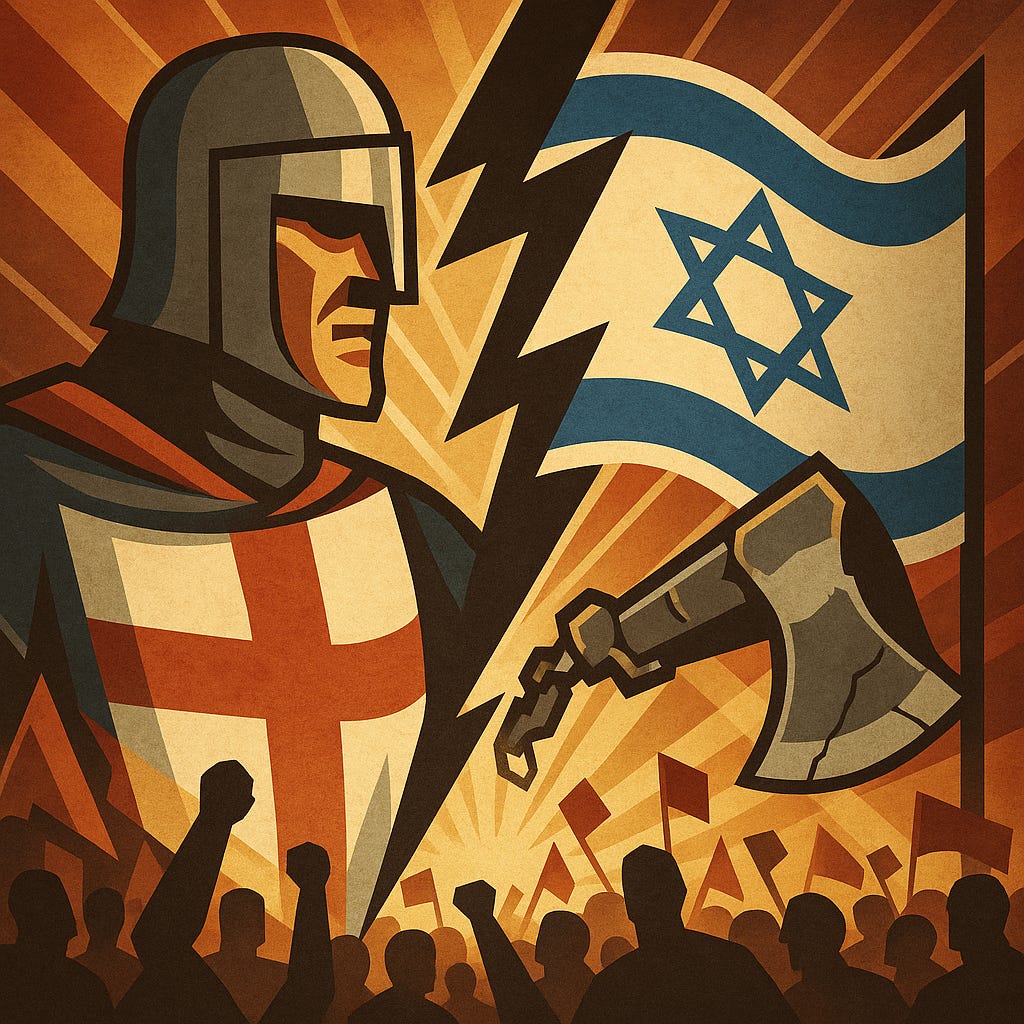
Robinson’s deployment of Crusader and nationalist symbols is not only selective but also deeply contradictory when placed against historical context.
The Crusades, often referenced implicitly through the imagery of the St George’s Cross, were characterised by widespread violence not only against Muslims but also against Jews. The Rhineland pogroms of 1096 saw Crusaders massacre Jewish communities in Mainz, Worms and Cologne enroute to the Holy Land (Chazan, 1996). When Jerusalem was captured in 1099, both Muslims and Jews were killed in large numbers (Riley-Smith, 2005). For Robinson and his supporters to wave the St George’s Cross alongside the Israeli flag is therefore historically incoherent: Crusaders represented not only the persecution of Muslims but also some of the most notorious episodes of medieval antisemitism.
Similarly, St George himself was not English but of Cappadocian and Levantine heritage, traditionally said to have been martyred in Lydda (modern Lod, Israel/Palestine). He is venerated today by Palestinian Christians and also respected by Muslims in the region (Bozóky, 2006). Robinson’s framing of St George as a uniquely English national icon ignores this Middle Eastern heritage and the saint’s broader religious significance across cultures.
These contradictions underline a recurring theme: Robinson appropriates symbols divorced from their complex histories to craft a narrative of national purity and civilisational struggle. Yet when placed in their proper historical context, these symbols tell a story of cultural hybridity, shared heritage, and — at times — Christian violence against Jews as well as Muslims.
Impact on Women, Minorities, and Communities
Central to Robinson’s activism is the claim that he is a defender of women, particularly against sexual abuse by Muslim grooming gangs. Yet the selective focus of his rhetoric, combined with the criminal record of both himself and several associates in related far-right organisations, undermines this claim.
Research by scholars and monitoring organisations shows that Robinson’s activism has had significant negative impacts on minority communities. Muslim communities in towns targeted by EDL demonstrations reported increased fear, harassment, and violence (Allen, 2011). Rather than protecting women, Robinson’s focus on “Muslim abusers” has reinforced racialised stereotypes, marginalising innocent Muslim women and men while failing to address the reality that sexual abuse occurs across all communities (Cockbain, 2013).
Robinson’s own record also complicates his claim to protect women. His harassment of journalist Lizzie Dearden demonstrates direct abuse against a woman in her professional and personal life (The Guardian, 2021). Moreover, his contempt of court actions endangered prosecutions of grooming gang members, potentially harming the victims he claimed to defend (BBC News, 2018).
For LGBT+ communities, Robinson’s 2025 “Unite the Kingdom” rally amplified anti-trans rhetoric, combining misogyny with hostility to gender diversity (Reuters, 2025). Likewise, for immigrant and Palestinian communities, his rhetoric and symbolism contributed to a hostile climate, where ethnic minorities were positioned as threats to national purity.
Thus, rather than offering protection, Robinson’s activism has often intensified harm, creating a climate of hostility in which women, Muslims, LGBT+ people, and immigrants have faced heightened risks of abuse and marginalisation.
Legal and Ethical Boundaries
Robinson frames his activism as a defence of women and children against sexual exploitation. Yet his focus has overwhelmingly been on Muslim-majority grooming gangs, a selective emphasis that both distorts the broader landscape of child sexual exploitation (CSE) in Britain and fuels racialised narratives.
Government reports and academic research have consistently shown that CSE is not confined to any one ethnic group. The Independent Inquiry into Child Sexual Abuse (IICSA) found that most child sexual abusers in Britain are white men, often operating in family, institutional, or online contexts (IICSA, 2022). Studies of prosecutions since the mid-2000s confirm that while some high-profile cases involved South Asian men, many grooming gang prosecutions involved predominantly white British offenders (Cockbain, 2013; CEOP, 2013).
Examples include networks of white British men convicted of organised sexual abuse in Shropshire (2012), Oxfordshire (2015), and Newcastle (2017). In Oxfordshire, seven white men were convicted of systematic abuse of underage girls in 2015 (BBC News, 2015). In Newcastle, Operation Shelter resulted in 18 convictions, many of them white British men who had targeted vulnerable young women (The Independent, 2017).
Robinson has rarely highlighted these cases. His silence on white-perpetrated grooming networks underlines the racial selectivity of his activism: he instrumentalises sexual abuse when it can be used to vilify Muslim communities, but ignores the prevalence of abuse among white British men. This selective framing not only misleads the public but also risks obscuring the structural and widespread nature of CSE across all demographics.
Conclusion
Tommy Robinson’s claim to be a protector of women and children collapses under scrutiny. His criminal record — spanning assault, fraud, contempt of court, and harassment — undermines his authority as a moral guardian. The symbols he employs, from the St George’s Cross to the Israeli flag, mask complex histories of persecution and hybridity, contradicting the narratives of purity and unity he seeks to project.
Crucially, Robinson’s narrative of grooming gangs is selective. While he relentlessly highlights abuse by Muslim men, he fails to acknowledge the many grooming gangs composed of predominantly white British men, despite extensive prosecutions since 2005. His activism therefore distorts the reality of child sexual abuse, turning it into a tool of racial scapegoating rather than a genuine commitment to protecting victims.
By ignoring the majority of offenders and focusing narrowly on Muslims, Robinson reinforces harmful stereotypes, deepens divisions, and marginalises entire communities. Meanwhile, survivors of CSE of all backgrounds risk being instrumentalised in a culture war rather than supported in their pursuit of justice.
In this light, Robinson’s activism is less about defending women and more about exploiting their suffering for political gain. The evidence shows not a defender, but a provocateur whose selective outrage, personal hypocrisy, and damaging symbolism contribute to greater harm rather than protection.
Reference List
Allen, C. (2011) ‘Opposing Islamification or promoting Islamophobia? Understanding the English Defence League’, Patterns of Prejudice, 45(4), pp. 279–294.
Al Jazeera (2025) ‘Over 100,000 attend London rally led by far-right activist Tommy Robinson’. Al Jazeera, 13 September. Available at: https://www.aljazeera.com/news/2025/9/13/over-100000-attend-london-rally-led-by-far-right-activist-tommy-robinson (Accessed: 21 September 2025).
AP News (2025) ‘Far-right activist Tommy Robinson leads huge London protest’. Associated Press, 13 September. Available at: https://apnews.com/article/e4c7bfd7d7fda25b3c4ef8ef7e0a2f53 (Accessed: 21 September 2025).
BBC News (2013) ‘Tommy Robinson quits English Defence League’. BBC News, 8 October. Available at: https://www.bbc.co.uk/news/uk-24423247 (Accessed: 21 September 2025).
BBC News (2015) ‘Seven men guilty of Oxford child sex abuse’. BBC News, 25 February. Available at: https://www.bbc.co.uk/news/uk-england-oxford-31636396 (Accessed: 21 September 2025).
BBC News (2018) ‘Tommy Robinson jailed for contempt of court over grooming case videos’. BBC News, 5 July. Available at: https://www.bbc.co.uk/news/uk-44740771 (Accessed: 21 September 2025).
Birmingham Mail (2018) ‘Senior EDL member jailed for sex abuse of schoolgirl’. Birmingham Mail, 12 December. Available at: https://www.birminghammail.co.uk/news/midlands-news/edl-member-sex-abuse-15541526 (Accessed: 21 September 2025).
Bozóky, E. (2006) Defenders of the Holy Land: St George and the Crusader Ideal. Turnhout: Brepols.
Casciani, D. (2019) ‘National Action’s Jack Renshaw guilty of grooming child’. BBC News, 5 June. Available at: https://www.bbc.co.uk/news/uk-48528813 (Accessed: 21 September 2025).
CEOP (2013) Threat Assessment of Child Sexual Exploitation and Abuse. Child Exploitation and Online Protection Centre. London: CEOP.
Chazan, R. (1996) European Jewry and the First Crusade. Berkeley: University of California Press.
Cockbain, E. (2013) ‘Grooming and the “Asian sex gang predator”: the construction of a racial crime threat’, Race & Class, 54(4), pp. 22–32.
Copsey, N. (2010) The English Defence League: Challenging our country and our values of social inclusion, fairness and equality. Faith Matters.
Garbaye, R. (2014) Ethnic minorities and local politics in Britain. Basingstoke: Palgrave Macmillan.
Hope Not Hate (2019) From the EDL to the mainstream: Far-right sexual abuse convictions. Available at: https://hopenothate.org.uk/2019/05/16/edl-sex-abuse-convictions/ (Accessed: 21 September 2025).
IICSA (2022) Child sexual exploitation by organised networks: Investigation report. Independent Inquiry into Child Sexual Abuse. London: IICSA.
Kenny, M. (2017) The Politics of English Nationhood. Oxford: Oxford University Press.
Reuters (2025) ‘Over 100,000 anti-immigration protesters march in London’. Reuters, 13 September. Available at: https://www.reuters.com/world/uk/over-100000-anti-immigration-protesters-march-london-2025-09-13 (Accessed: 21 September 2025).
Riley-Smith, J. (2005) The Crusades: A History. 2nd edn. New Haven: Yale University Press.
The Argus (2018) ‘EDL speaker Peter Gillett jailed for child rape and cruelty’. The Argus, 8 December. Available at: https://www.theargus.co.uk/news/edl-speaker-peter-gillett-jailed/ (Accessed: 21 September 2025).
The Guardian (2021) ‘Tommy Robinson handed stalking protection order after harassing journalist’. The Guardian, 18 February. Available at: https://www.theguardian.com/uk-news/2021/feb/18/tommy-robinson-given-five-year-stalking-order (Accessed: 21 September 2025).
The Guardian (2022) ‘Tommy Robinson ordered to pay £100,000 damages to Syrian refugee boy’. The Guardian, 22 July. Available at: https://www.theguardian.com/uk-news/2022/jul/22/tommy-robinson-ordered-to-pay-100000-damages-to-syrian-refugee-boy (Accessed: 21 September 2025).
The Guardian (2024) ‘Tommy Robinson admits contempt of court over false claims about refugee’. The Guardian, 28 October. Available at: https://www.theguardian.com/uk-news/2024/oct/28/tommy-robinson-admits-contempt-of-court-over-false-claims-about-refugee (Accessed: 21 September 2025).
The Guardian (2025) ‘Unite the Kingdom: Far-right rally in London sees police assaulted’. The Guardian, 13 September. Available at: https://www.theguardian.com/uk-news/2025/sep/13/unite-the-kingdom-far-right-rally-london-tommy-robinson-police-assaulted (Accessed: 21 September 2025).
The Independent (2017) ‘Newcastle grooming gang: 18 men and women jailed for sexual exploitation of vulnerable girls’. The Independent, 9 August. Available at: https://www.independent.co.uk/news/uk/crime/newcastle-grooming-gang-jailed-sexual-exploitation-vulnerable-girls-operation-sanctuary-a7884766.html (Accessed: 21 September 2025).
The Jewish Chronicle (2010) ‘Board of Deputies slams EDL’s attempt to woo Jews’. The Jewish Chronicle, 15 October. Available at: https://www.thejc.com/news/uk/board-of-deputies-slams-edls-attempt-to-woo-jews-1.18401 (Accessed: 21 September 2025).
The Week (2021) ‘Tommy Robinson: a timeline of legal troubles’. The Week, 14 April. Available at: https://theweek.com/crime/tommy-robinson-a-timeline-of-legal-troubles (Accessed: 21 September 2025).